Performances Pt. 5
Corner-Of-The-Room Banter

When you go to see your favorite artist perform live, do you like when they talk between songs?
I’ve known people who really like when the artists they pay money to go see engage with the audience by introducing songs, making jokes, referencing the city and/or state where they are performing, and just commenting in general on different and various things throughout the show. I’ve also known people who really do not care about any of that stuff at all and are just there to hear the music. Dare an artist choose to make political statements from the stage and it can certainly lead to interesting consequences in a live setting. The individuals who go to a Roger Waters or Neil Young concert and get turned off by this amaze me. I guess they just happened to miss the last 60 years of opinions these guys have shared on things.1
Personally, I enjoy when artists engage with the audience by talking between songs regardless of what the subject matter may be. But what about the performer in a winery or brewery who is really often there only as “musical wallpaper” performing in the background while patrons imbibe, laugh, and converse with one another during an afternoon or evening out to unwind and enjoy themselves?
At a concert where you’ve paid to see a performer, they are clearly the center of attention and there to entertain you so my unscientific claim is that most attendees probably want the performer to engage with them from the stage in some capacity throughout the show.
On Peter Gabriel’s 2023 tour supporting his album, i/o, he spoke before just about every single song, usually introducing a piece of artwork he had selected to complement the song. The artwork would display on the screens behind him and his band as they performed the song. It was an extremely unique live concert experience—part rock show, part art exhibition, total direct engagement with the audience.
Conversely, Bob Dylan rarely speaks between songs during his live shows nowadays. From some reports, the stage is kept so dark at the start of some shows that many in the audience fail to realize he has even started playing!
That’s entertainment.
But what about the acoustic act playing in the corner of a winery at 1 o’clock on a Sunday afternoon or set up at the front of a long narrow bar in a strip mall from 7-9pm on a Thursday night? We are also there to “entertain” but we are quite certain in most cases that we will not necessarily be the center of attention. Sometimes the best we can hope for is the establishment lets us set up somewhere other than next to the TV showing the NBA playoffs. Less certain, however, is knowing if those in attendance want to actually hear us provide any stage banter—or in my case on most occasions—corner-of-the-room-where-I’ve-set-up-all-my-shit banter.
Over the years I’ve taken different approaches to audience engagement and it usually just comes down to the specific situation; my setlists are usually very mapped out, but engagement will vary depending on the circumstance. I’m more likely to talk between songs if it’s a very attentive audience or if even just a few individuals seem to be very engaged and interested in what I’m doing. On occasions where I’m just doing my thing while most of the crowd is doing theirs, I’m less likely to talk much between songs other than at the start and end of each hour long set.
Though this intuitively feels like the right thing to do, I often wonder if it is. Am I not engaging with the crowd because they are not that engaged with me, or is the crowd not that engaged with me because I am not engaging with them?
Over the years I’ve gravitated towards the approach that I am the background music to most of the people in attendance engaged in conversation so why should I overly go out of my way to interrupt—kind of like when you’re mid-meal at a restaurant and the waiter keeps coming over repeatedly to ask if everything is ok or if you’re “still working on that?” Coming over once or twice is fine, appreciated, and expected, but multiple times? That can get annoying. So I tend to think in similar terms — speaking once or twice every now and then seems required and appreciated, but too many times and I just wonder if I’m just crossing over into Annoying Land.
On occasion over the years I’ve had several people come up to me after a performance to tell me they enjoyed the performance and thanked me for not being too loud/in-their-face so that they could enjoy their conversations. So it seems to always come down to reading the majority of the room when deciding on how often to engage with people.
Yet recently when I was alone in my music room practicing and going over songs I was going to play at my performance last week at Paradise Springs Winery, I forced myself to just start talking out loud for a few seconds either before or after every song I played. Before “Pour Your Heart Out Over Manhattan,” I uttered “This is a song about being young and bar hopping around New York City.”
After going through my version of Mazzy Star’s “Fade Into You,” I announced to my empty music room, “What I love about that song is that when it came out teenagers absolutely loved it, and 30 something years later, teenagers still absolutely love it.”
Finding first-year college students discuss the song, include it in playlists, and mention it in essays over the past three years confirm to me that this is true and it’s part of the appeal of performing it. Not as many songs truly transcend generations as we may think.
Before “High School Reunion,” I opted to go into more detail and spoke about the inspiration behind the song.
When I wrote it 13 or so years ago, Facebook had much more cultural significance than it does today. It had long usurped MySpace as the most popular and relevant social media platform and my upcoming 20th high school reunion at the time was being organized via the site. Rather than the old days where you may get one or two invites in the mail leading up to your high school reunion, for a full year before my 20th was about to take place, there were regular—sometimes weekly—notifications about it. A Holy Trinity High School Class of 1994 Facebook Group had been created and members (aka former high school classmates) were exchanging details on a regular basis for months leading up to the event.
Since I was in Virginia and had a fairly ordinarily high school experience, I wasn’t planning to travel back to Long Island to attend, but I did wonder what I would have done had I still been living in New York at the time. Like nearly everyone, there were many great aspects of my high school experience, but there were many painful ones as well. Although I liked nearly everyone and still kept in touch with some that were involved in organization the event, I did not consider any of them truly close friends. With this in mind, and with that uncanny ability of Facebook to never let you miss certain updates on things, I decided to write a song from the perspective of someone who may have still had some old wounds from high school and couldn’t decide whether or not to attend their reunion.
Paraphrasing all of this out loud was the the most in-depth I went during this little exercise of talking out loud to myself about every song I played.
Sometimes I would just throw out something I thought was humorous (“That’s a song by someone almost as handsome as me” after Harry Styles’ “As It Was” or deadpan: “I recently read that “Take Me Home” was inspired by One Flew Over The Cuckoo’s Nest…on that happy note, I’m going to take a break. Be back in 10!”).2
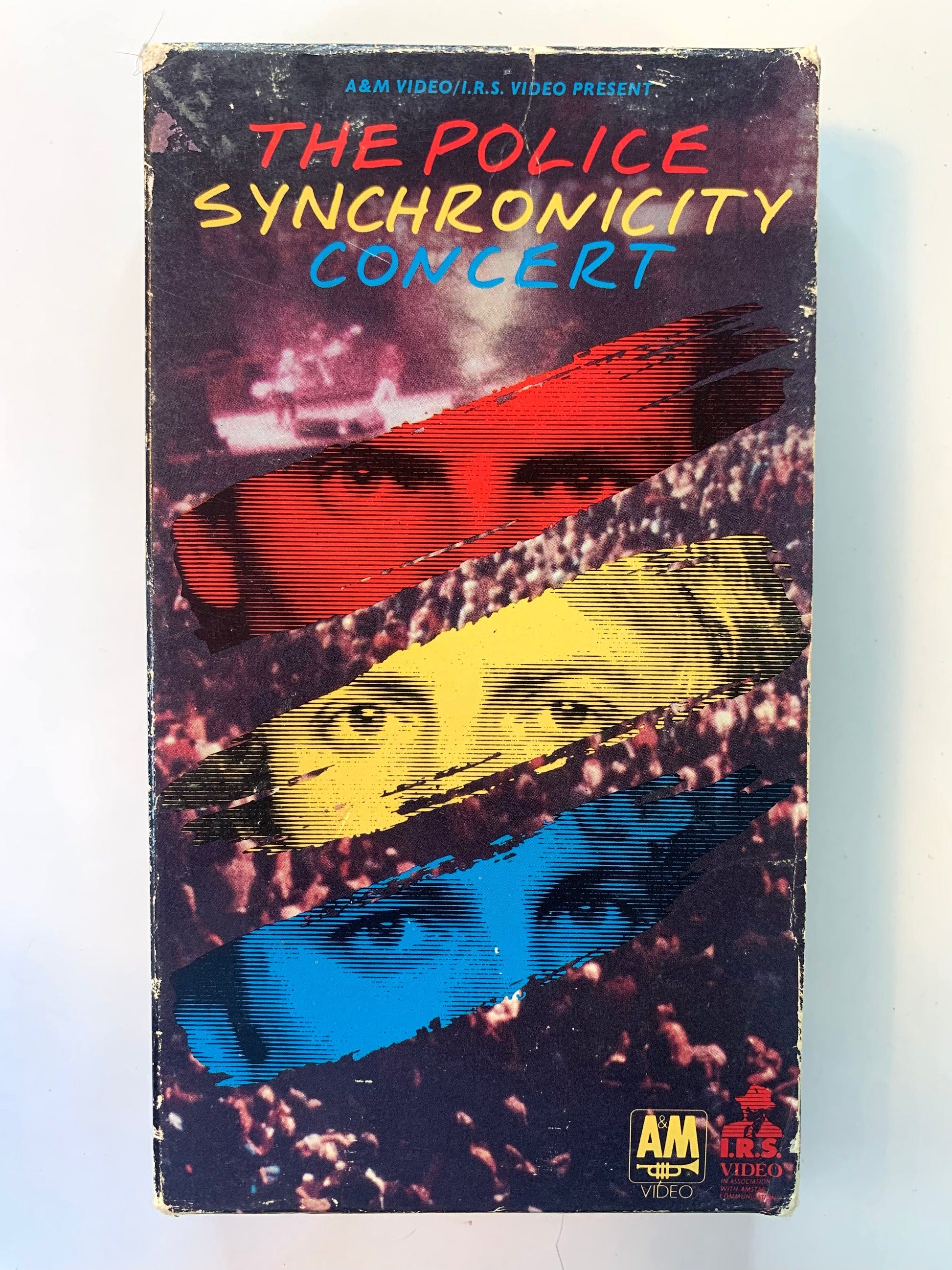
I’ve recently been re-reading John Warner’s excellent book, More Than Words, on writing and AI as part of a book group at UMW and in the chapter on writing as a practice, he recounts Adam Grant’s “deliberate play” and Steph Curry’s philosophy of fun combined with discipline. I thought of this as I forced myself to blurt things out off the top of my head about each song as if I was indeed talking to a room full of people who were interested in what I had to say. It did make practicing more fun and enjoyable, and took me back to when I was 11 years old before ever learning to play the guitar when I would sneak into my brother’s room when home sick from school, grab his white Charvel bass guitar, and mime Sting’s moves I had watched hundreds of times from the VHS tape of the Synchronicity tour.
Although I was saying something before or after just about every song I practiced, I knew it was unlikely I would do the same at the gig. Still, this approach to practice made it more fun and lively, and also helped remind me of the connections I have to the songs I play by having to come up with something to say about each one. Since you never know based on the crowd when you may wish to engage with them, it was good practice to have something in mind for every song should the moment arise to want to share. Some words that came off the top of my head sounded more or less good as they were, while others struggled to survive for coherency before I put them out of their misery and just closed my mouth. Time to either toss that idea away or edit it further at a later date. Sounds like a familiar process.
After a couple of weeks of this, I felt like I had at least something to say about just about every song I planned to play. I still decided though that it was ultimately going to depend on the room that day as to what, when, and how much I would decide to share. This particular gig on May 2nd had an average crowd that hovered around 20 throughout the afternoon—at some points there were 4 people sitting in front of me, and at other points there were maybe as many as 30 in the room. Since it wasn’t that overwhelming or that loud of an audience, I definitely spoke more than I usually do, but I still kept it to a minimum. Still swirling around my head for the most part was that people seemed to be enjoying their conversation and who was I to interrupt? But, here’s the setlist followed by some of the things that eventually made it to the microphone.
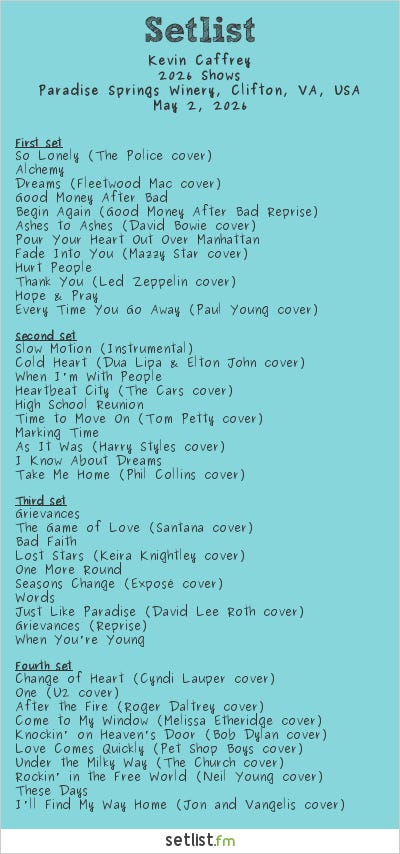
As I usually do, I spoke between the first song and the second song of the afternoon because you definitely need to introduce yourself:
“Good afternoon all you good people of Clifton3 my name is Kevin Caffrey from Fredericksburg and I’m going to play a lot of covers for you this afternoon like that one from The Police and also a lot of originals. This is one of mine from an album I put out a few years ago called Alchemy.”
A few songs later in the first set I introduced “Good Money After Bad” simply by saying it’s a song about how “it’s never too late to start over again.”
In the second set after I finished playing Petty’s “Time To Move On” I mentioned it was a great song to blast in your car after you’ve quit a job, and then I segued into “Marking Time” by mentioning how it was a song about meeting my wife.
I mentioned the One Flew Over The Cuckoo’s Nest factoid after playing “Take Me Home,” and during the third set I made a point to credit “Lost Stars” as a song written by Gregg Alexander from a great film called Begin Again about connecting through music. After playing Melissa Etheridge’s “Come To My Window” in the final set, I decided to just honestly tell the audience that one of the main reasons I enjoy playing the song is because of how good the bridge is and just replayed that part to demonstrate.4
I ended the afternoon calling “These Days,” a song about perseverance and then restated my name and thanked the remaining people in the room for listening. A joke I also end a lot of performances with followed:
“If you’ve liked what you heard, please take a free CD. And if you didn’t like what you’ve heard, I still suggest you take a free CD and just give it another chance in the comfort of your own home.”
I then introduced the last song of the afternoon as one of my favorites, a collaboration between Jon Anderson of Yes and the late Greek composer Vangelis called “I’ll Find My Way Home” that I often close performances with because it is peaceful, calm, and contains final lines that have multiple meanings:
“No question I’m not alone/somehow I’ll find my way home/somehow I’ll find my way home.”
After the sound of the final G chord faded, and hours of playing music have come to an end, I shared the final sentiment of the afternoon:
“I hope you all find your way home safely tonight, and every night. Thanks again for listening. Goodnight.”
a little background on “I’ll Find My Way Home” recoded during COVID
When I saw Waters on his This Is Not A Drill Tour in 2022, a preshow recorded message from Waters himself announced to the audience about 15 minutes before the show began: “If you’re one of those ‘I love Pink Floyd, but not Roger’s politics’ people you might want to fuck off to the bar right now.” That’s one way to engage with your audience.
True according to a 1997 episode of VH1 Storytellers.
There were approximately four people in the room when I said this.